Massachusetts has long been a leader in climate and energy. In 1997, Massachusetts became one of the first states to implement a renewable portfolio standard aimed at scaling renewable generation and reducing emissions. In the decades that followed, the Commonwealth implemented policies to support these goals with incentive structures ranging from net metering to Solar Renewable Energy Credits, and development followed this political tailwind.
For years, the solar market excelled - but the regulatory framework was not built to manage post-pandemic supply chain constraints, rising costs, or interconnection delays. Installation of utility- and distributed-generation-scale projects fell rapidly. Today, with thinner pipelines and net-zero goals looming, the Commonwealth is working to address the bottlenecks developers face.
MA DG Solar Incentive Structure
To revitalize distributed generation solar, Massachusetts launched the third iteration of the Solar Massachusetts Renewable Target program (SMART 3.0) in September 2025. Where the previous incentive structure did not allow regulators to adjust compensation as market conditions changed, SMART 3.0 is built to be flexible while remaining bankable. The program makes 600 megawatts of capacity available for projects in 2026, with additional capacity to be allocated in future years. Annually, compensation rates are baselined against current costs, with guardrails to limit swing (annual rate adjustments are capped at a maximum change of 20% or $0.01/kWh per category relative to the preceding program year). The regulators favor certain types of projects: agrivoltaics, canopies, and community solar projects receive additional compensation, among other project types. Greenfields, on the other hand, face fees for ecological impact and new assessments for program eligibility.
The Commonwealth is also pushing storage-coupled solar projects; SMART 3.0 requires systems larger than 1 MW AC to co-locate solar with batteries, although projects with certain locational adders are exempt.
The Takeaway: Case studies on the program are limited thus far. The Department of Public Utilities (DPU) approved the tariff that enables final qualification in July, and the 2027 incentive rate hasn’t been released yet. But the program exists to address the reality developers face: rising costs, nascent domestic supply chains, and ITC phase-out.
Permitting Reform
Municipal permitting is a major roadblock for Massachusetts developers. Disparate zoning bylaws, multiple required approvals, and local opposition can lead to an expensive process that delays project schedules. If a permit is denied, appeals head to court, where costs mount and timelines are open-ended. The risk is substantial; in our experience, projects in Massachusetts require an average of three to seven local discretionary approvals, any one of which can make or break a project.
To address this, the Commonwealth passed the 2024 Climate Act. The reform replaces fragmented local and state approval processes with a consolidated, time-capped permitting framework, but the specific pathway depends on project size.
Small Projects (<25 MW AC solar / <100 MWh BESS)
For DG-scale projects, Massachusetts is consolidating the local permitting process. Rather than submitting separate applications to multiple municipal boards and departments, developers can use a single application covering local approvals such as zoning, conservation, and stormwater. Municipalities must issue a decision within 12 months; if they fail to act within that statutory window, the permit is automatically approved. Decisions must adhere to baseline health, safety, and environmental standards set by the Executive Office of Energy and Environmental Affairs. If an appeal is needed, it is referred to the Energy Facilities Siting Board (EFSB), rather than going to court.
Alongside these developer-facing reforms, the Commonwealth has worked to better equip the municipalities reviewing these applications. A model bylaw has been released—something the industry has requested for years as volunteer boards have grappled with regulating technically complex systems. The Commonwealth is in the process of creating technical review materials for these boards to use when reviewing the system—a third-party, trusted resource developers can point to as permitting progresses.
For developers, the benefit is improved predictability: a defined permitting pathway, a 12-month statutory clock, and a single appeal process could make project timelines easier to underwrite.
Large Projects (>25 MW AC solar / >100 MWh BESS)
For utility-scale projects, the 2024 Climate Act establishes a single consolidated state permit issued by the EFSB. The EFSB is required to issue a final, binding decision within 15 months of determining application completeness, replacing a process that previously consumed one to four years before local permitting even began. This single permit supersedes all individual state, regional, and municipal approvals. If a decision is appealed, it bypasses lower trial courts entirely and proceeds directly to the Supreme Judicial Court (SJC), significantly reducing the open-ended litigation risk that has historically threatened project timelines.
Protecting Land and Towns
While the permitting reform aims to spur development, the Commonwealth also wants to ensure that projects are well-sited. To evaluate sites, two additional compliance layers were added:
- Site Suitability: All applicants must now conduct a geospatial Site Suitability Assessment scoring the project footprint across five criteria: carbon sequestration, biodiversity, climate resilience, development suitability, and environmental burdens. Lower scores favor preferred sites like brownfields; high scores trigger stricter mitigation requirements and fees, making this a meaningful input to early-stage site selection.
- Environmental Justice: For projects near Environmental Justice communities, developers must also conduct a Cumulative Impact Analysis and execute a Community Benefits Agreement, covering commitments such as local hiring, energy bill discounts, or infrastructure investments, as a prerequisite for achieving complete application status. Neither requirement can be deferred to later in the process.
The Takeaway: Permitting in Massachusetts has always been complicated, and that isn’t going away. But the 2024 Climate Act meaningfully reduces risk. Unknown timelines, varying costs, and bureaucratic red tape are being replaced with defined statutory requirements and hard deadlines. The Environmental Justice and site suitability requirements add new compliance layers—but they are defined and predictable, which is ultimately what the industry has been asking for.
Storage Mandate
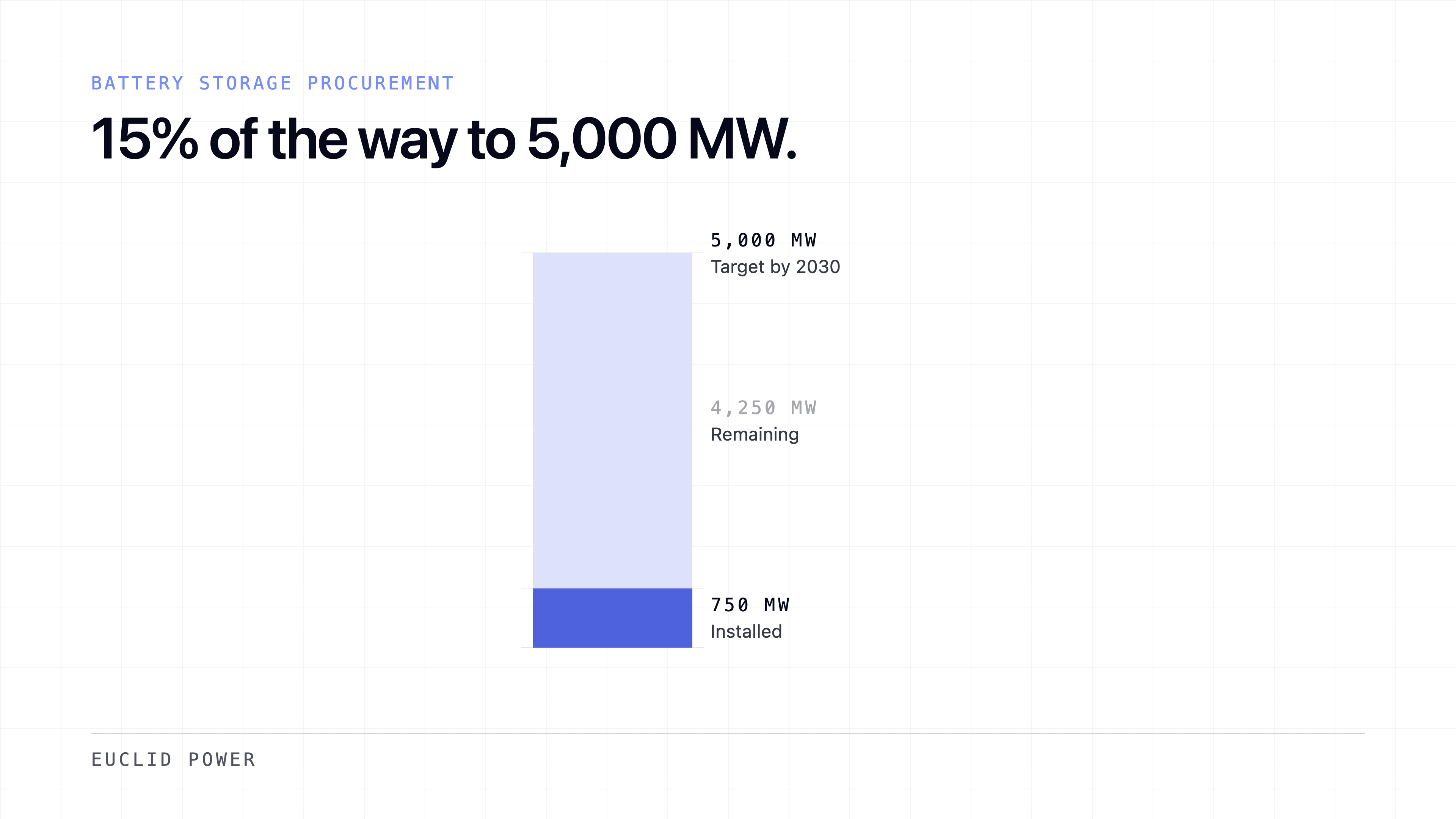
In 2024, the Commonwealth put an emphasis on storage, recognizing the need to store renewable energy and discharge during peak demand periods. Utilities are required to procure 5,000 MW of battery storage by 2030. The framework categorizes this target into three operational regimes: mid-duration storage (3.5 GW), long-duration storage (0.75 GW), and multi-day storage (0.75 GW). As of early 2026, installed capacity stands at approximately 750 MW, roughly 15% of the 2030 goal, meaning the substantial majority of the build-out is still ahead.
This isn’t just for utility-scale players. The 2026 solicitation included a call-out for 250-300 MW of DG storage to be procured. Developers pursuing this market can access three primary revenue streams: the Clean Peak Energy Standard (CPES), ConnectedSolutions demand response, and SMART 3.0 storage adders.
The Takeaway: Unlike the newer incentive and permitting reforms, the storage mandate is clearly in motion—targets are set and solicitations are running. With only 15% of the 5 GW target met as of early 2026, there is significant runway ahead. It's a clear, near-term entry point into the Massachusetts market for developers today.
Interconnection Reform
Massachusetts' interconnection queue has been a structural constraint on deployment for years. The problem isn't unique to Massachusetts — across the broader ISO-NE control area, only 13% of projects submitting interconnection requests between 2000 and 2019 reached commercial operation, with 77% withdrawing due to unforeseen network upgrade costs.
Utility Scale Track: Federal Reform and the ISO-NE Queue Overhaul
To address this for utility-scale projects, ISO-NE is replacing its legacy serial study process with a "first-ready, first-served" cluster study model under FERC Order 2023. The reformed queue reopens for new applications on October 5, 2026. For developers, the new process runs on a structured 460-day cycle: a 45-day application window, 60 days for scoping and model validation, 270 days for cluster studies, and a 40-day commitment window before moving into final engineering. Entry barriers are meaningfully higher; a flat $250,000 study deposit replaces the prior variable tier system, and developers must demonstrate 100% site control (leases, options, or title) at application submission, with no extensions. Failure to maintain site control results in immediate queue withdrawal. The intent is clear: fewer speculative applications, and faster processing for projects that are genuinely ready.
-selection.png)
DG Track: ASO Studies and the CIP Mechanism
DG projects interconnect through a separate queue administered by the electric distribution companies, rather than through the ISO-NE transmission queue. This means DG projects come with their own set of bottlenecks. Namely, when localized clusters of solar and storage apply within the same distribution subsystem, ISO-NE can mandate an Affected System Operator (ASO) study evaluating reverse power flows into the bulk transmission network. These studies have historically frozen hundreds of megawatts of development. Today, DG MA solar and storage projects spend an average of 838 days in the queue.
The result of the study is often significant grid upgrades, which smaller projects do not necessarily have the economics to support. To address this, Capital Investment Projects, or CIPs, are cost-sharing mechanisms. CIPs distribute upgrade costs between ratepayers and the benefiting project(s), rather than placing the full tab on a single developer. The process has not been faultless—the cost-sharing agreement takes significant time to be approved at the DPU and CIPs have dissolved as projects drop out of the queue—but it represents a meaningful change in principle.
Grid Modernization: Electric Sector Modernization Plans (ESMPs)
On the proactive planning side, something the industry has been requesting for years, the Massachusetts Electric Distribution Companies (EDCs) filed Electric Sector Modernization Plans approved by the DPU in August 2024. This authorizes approximately $3.4 billion in capital investment between 2025 and 2029:
- National Grid is committing $1.5 billion to rebuild or upgrade 13 bulk substations and 14 feeders, unlocking 800 MW of new distributed hosting capacity by 2029, with another 2,900 MW targeted through a 2030–2034 phase.
- Eversource is directing $1.0 billion toward clean energy enablement, including upgrades to 14 bulk substations and three new substations adding 2.2 GW of hosting capacity.
- Unitil is deploying $50 million in targeted circuit upgrades across central Massachusetts.
This is the grid being built ahead of demand, rather than in reaction to it.
The Takeaway: CIPs mark a change in principle—shared cost burden instead of developers absorbing it alone. The FERC Order 2023 reforms and the October 2026 queue reopening represent a structural reset at the wholesale level, with real teeth: higher deposits, hard site control requirements, and defined study timelines. The ESMP investments signal that the distribution grid is finally catching up to the clean energy buildout. The interconnection picture in Massachusetts is genuinely improving, but the transition window through 2026 and 2027 will require patience.
Looking Ahead
Massachusetts isn't solving its DG solar and storage headwinds with any single lever. SMART 3.0, siting reform, the storage mandate, and interconnection changes each chip away at a different piece of the same problem: cost, timeline, and grid capacity risk. Taken together, they signal a state working to improve the situation for developers and maintain their position as a leader in clean energy. The near-term picture is still one of transition: new tariffs, model bylaws, and consolidated permitting processes are untested at scale, and 2026-2027 will be the real test of whether they deliver on their promise. Three structural shifts will define what comes after:
- First, storage dispatch economics are changing. Heat pumps and EVs are projected to flip ISO-NE into a winter-peaking regime by 2034–2035, shifting value away from short-duration summer afternoon shaving toward winter morning and evening demand surges. CPES and demand response frameworks are already beginning to weight winter and multi-day performance accordingly.
- Second, data centers are creating a new offtake class: Executive Order 658 (September 2026) requires commercial facilities exceeding 25 MW of peak demand to procure 100% clean energy and execute CBAs, effectively seeding a corporate PPA market within ISO-NE.
- Third, capital discipline is now table stakes. With FERC Order 2023 site control rules eliminating speculative queue strategies, winning projects will be built on precision site selection using state-guided site screening, early community engagement, and layered revenue stacks.
For a market that stalled out post-pandemic, the direction of travel is unmistakable: Massachusetts is rebuilding the regulatory scaffolding it needs to hit 2050 its net-zero target. The new framework will reward developers who engage early, build intentionally, and operate with the discipline it demands.
Enjoying this deep dive?
Stay up to date on market insights for teams who build, buy, and finance renewable projects.