A solar project goes to market at a headline valuation of $0.20/Wdc. By the time negotiations conclude, more of the purchase price is contingent on the project reaching Notice to Proceed and Commercial Operation milestones, part of the consideration is held in escrow, and interconnection costs are subject to future true-ups. Instead of accepting those uncertainties at face value, buyers build them into the transaction with risk-allocation mechanisms.
Increasingly, the team bringing a renewable asset to market isn't the same team that developed it. Finance and investment teams often lead sale processes while sitting several steps removed from the development and construction teams that built and documented the project. As information gets fragmented, assumptions get harder to verify and important context can be lost.
Buyers evaluate projects through models, and they look for reasons to make the inputs more conservative. Unresolved questions around interconnection costs, permitting, schedules, or development history become transaction risks that buyers address through lower valuations, deferred payments, holdbacks, and other protective measures.
Preparing an asset for sale means identifying and reconciling those uncertainties before they reach the market. Every diligence gap eventually receives a number—the question is whether the seller or the buyer is the one assigning it.
The knowledge didn't travel with the asset
Large renewable energy projects often change hands multiple times before reaching commercial operation, and the team in charge of selling an asset may not have been very involved in developing it. The various teams that contributed information throughout the project lifecycle—development, engineering, construction, finance—may not have documented in the same way or with the needs of a future transaction in mind.
Over time, project knowledge becomes fragmented, with key assumptions scattered across financial models, engineering studies, email chains, or team members' minds. Supporting documentation can be hard to locate. And the people who negotiated an interconnection agreement, selected a supplier, or made a big permitting decision may no longer be involved by the time the project enters a sale process.
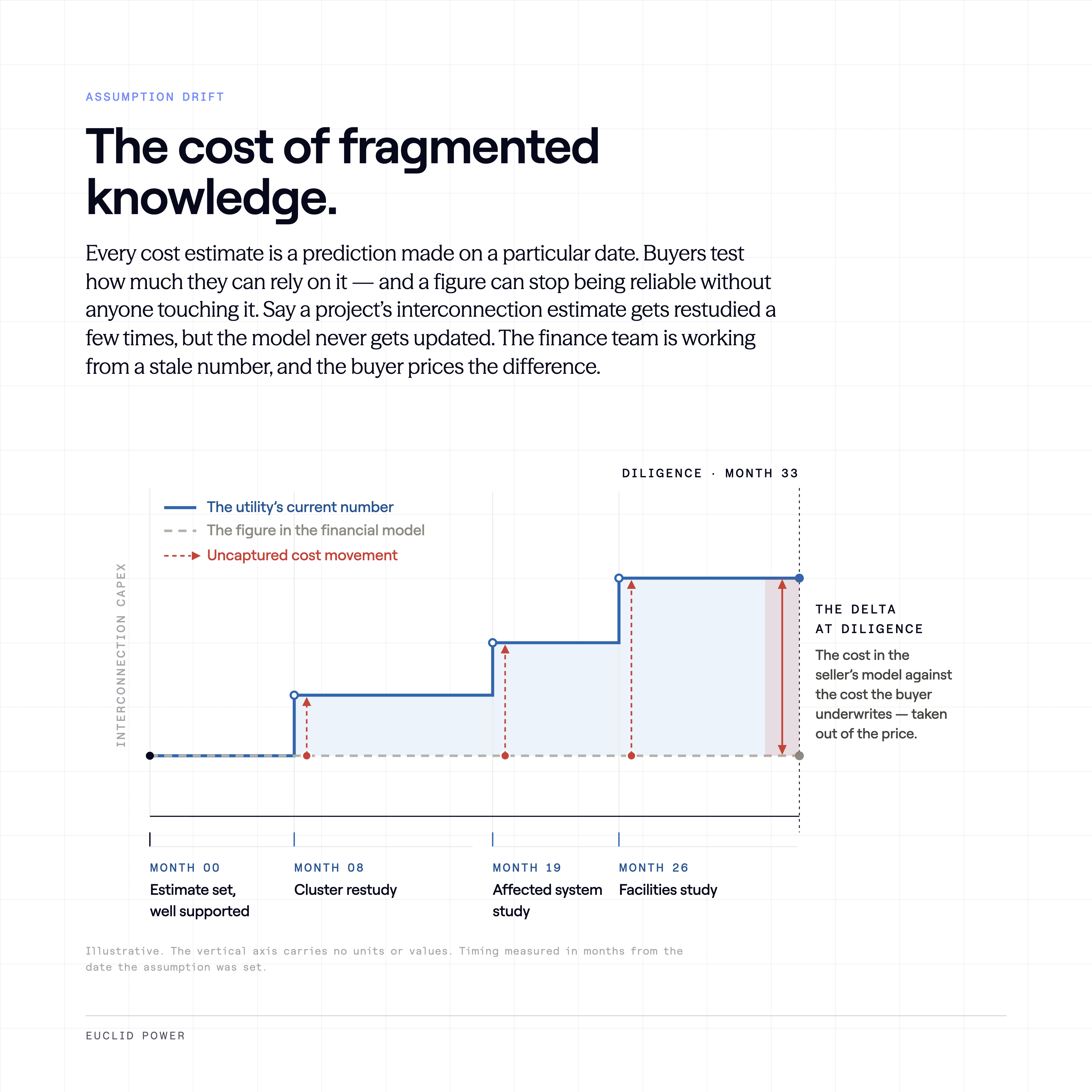
Most of these gaps don't affect day-to-day project execution, but their significance becomes clear when buyers start asking questions. How were interconnection costs estimated? Is equipment pricing still supported by current supplier quotes? Are permitting and construction schedules still realistic? If the seller can't provide clear, well-supported answers, the buyer has little choice but to treat that uncertainty as additional risk.
Getting an asset ready for sale therefore starts long before diligence. It means organizing information, reconciling assumptions across technical and financial workstreams, and making sure the project's history can be understood by people who weren't involved in creating it.
Buyers price uncertainty, not intent
Every cost estimate, schedule, engineering study, and revenue forecast is a prediction of a project’s future performance. During diligence, buyers test those assumptions to figure out how much they can rely on them, and how much uncertainty they need to price into the transaction.
A cost estimate that can't be reconciled may lead to a purchase price adjustment or an interconnection cost true-up. For earlier-stage projects, buyers may defer a larger portion of purchase price until events such as Ready-to-Build approval, notice to proceed, or Commercial Operation Date, when key development and construction risks have been retired. Other uncertainties may prompt buyers to negotiate larger escrows, holdbacks, or other protections that shift more risk back to the seller.
These distinctions matter for sellers, since diligence gaps determine who bears the cost of uncertainty. If sellers don’t quantify and address risks before entering the market, buyers will assign their own value to them, and they almost always err on the side of caution.
Every diligence gap becomes a financial adjustment
Diligence findings change how deals are structured and how risk is allocated between buyer and seller. Rather than eliminating uncertainty entirely, transaction agreements often include mechanisms that allow parties to adjust economics as project assumptions become clearer. Executed solar MIPAs show how these risks are handled in practice. In SPI Energy’s publicly filed 10-K, the purchase agreement included provisions addressing purchase price adjustments and interconnection cost reimbursement, allowing the parties to reconcile differences between initial assumptions and final project conditions.
These mechanisms become especially important when a key project assumption is unresolved. Suppose a project's financial model assumes $18 million in interconnection upgrade costs, but the supporting documentation is outdated or the estimate can't be reconciled with the latest utility correspondence. Instead of accepting that figure at face value, a buyer may negotiate an interconnection cost true-up, allowing the purchase price to be adjusted if actual costs exceed an agreed-upon threshold. Similar provisions show up in executed purchase agreements, where interconnection costs are reconciled after closing and any difference is reflected in the final transaction value.
Milestone payments serve a similar purpose. If buyers have concerns about permitting, procurement, or construction assumptions, they may defer a larger share of the purchase price until the project reaches Ready-to-Build (RtB) or Commercial Operation Date (COD). Instead of paying the full agreed value at closing, they tie future payments to milestones that demonstrate key risks have been retired.
Other uncertainties can reshape transaction terms in more subtle ways. Buyers may negotiate larger escrows to cover potential liabilities, extend diligence periods to verify outstanding questions, or build additional schedule protections into agreements if they think development timelines are too optimistic.
Getting dressed for the sale
Preparing an asset for sale requires more than assembling a data room and organizing project documents. The strongest sellers enter the market with a clear understanding of the questions buyers are likely to ask and the evidence needed to answer them.
That preparation starts with reconciling the assumptions that support the project's value. Are interconnection costs based on the latest utility information? Do equipment specifications match the assumptions in the financial model? Are permitting timelines, construction schedules, and development milestones supported by current documentation? Addressing these questions before diligence starts lets sellers pinpoint gaps while they still have time to resolve them.
A well-prepared asset also has a clear record of how key decisions were made. Buyers may not expect every project assumption to remain unchanged, but they need confidence that those assumptions can be traced, explained, and updated when conditions change. Organized documentation, consistent financial and technical records, and a complete data room help reduce uncertainty and keep diligence focused on the asset's merits instead of unanswered questions.
Sale readiness is ultimately about quantifying risk before someone else does. The work should start well before an asset reaches the market, with sellers reconciling items such as interconnection costs against the latest utility correspondence, checking permit expiration dates, and testing supplier and EPC quotes against the assumptions in the financial model. Not every gap needs to be fixed, but sellers should understand the cost to cure each one relative to the price impact of leaving it unresolved. Some issues are cheaper to resolve before market; others may be better handled through transaction terms. The key is making that decision before the buyer does.Sellers that understand their own diligence gaps can decide which issues to resolve, which risks to retain, and how to structure the transaction accordingly. Waiting for buyers to uncover gaps means giving up control over how the market values them.
Readiness determines the outcome
As renewable assets get more complex and transactions involve more stakeholders, skillfully transferring project knowledge has become a competitive advantage. A project’s value depends on its technical and financial characteristics, but just as much on how clearly those characteristics can be demonstrated to a new owner.
Strong sellers treat diligence preparation as an extension of project development, not a final step before entering the market. By maintaining consistent records, reconciling assumptions, and identifying unresolved risks early, they create a clearer path for buyers to evaluate the asset and allocate capital with confidence.
In a market where buyers are increasingly selective, transaction outcomes are shaped long before a deal process starts. The work required to prepare an asset for sale may happen behind the scenes, but it ultimately determines how much value a seller can preserve when the asset reaches the market.
Enjoying this deep dive?
Stay up to date on market insights for teams who build, buy, and finance renewable projects.