The ups and downs of the solar industry have earned it the reputation of being a “solarcoaster.” When times are good—that is, policy is supportive, supply chains are stable, and there’s available grid capacity—developers and investors flood the market, driving competition for land, interconnection queue positions, and early-stage projects. This was the case from 2021 to 2023, so much so that proposed solar and storage capacity in interconnection queues hit an all-time high.
But what goes up must come down, particularly in the world of roller coasters. In 2025 and 2026, the federal headwinds, namely ITC phaseout, PFE regulations, and tariffs, made some developers realize they’re not positioned to weather the downturn. Projects that once fit their growth strategies may no longer align with their capital, timeline, or risk tolerance. Opportunities thus emerge for other developers and IPPs to acquire projects mid-development.
Buying at this stage has its advantages. Securing land is only getting harder, and an executed site-control agreement can be valuable in its own right. Acquiring a project that has already entered the interconnection queue can also save years of development time. And of course, the price tag is going to be lower than that of an NTP-ready asset.
That discount, however, comes with a different risk profile, from permitting and interconnection studies to site control, project economics, and the likelihood of reaching construction. In fact, according to developers, around a third of utility-scale solar projects ultimately get canceled after submitting a permitting application, resulting in an average sunk cost of $2 million per project. Effectively underwriting a pre-NTP project requires assessing what’s actually been secured versus what remains unresolved and, ultimately, what it will take to get to NTP.
A Different Pricing Structure
For an NTP-ready project, a membership interest purchase agreement (MIPA) typically involves a hefty upfront payment at closing, with additional payments tied to standard milestones like FNTP and COD. In a mid-development acquisition, buyers may instead negotiate a smaller payment at closing and look to defer the payment milestones until key development risks are resolved.
To illustrate this in practice, Euclid supported the acquisition of a number of early-stage ERCOT projects. The buyer kept the developer of the projects on, even after close, under Development Services Agreements. The owner paid a small upfront payment or development reimbursement cost. From there, the parties agreed to a development budget and milestone payments—further spend is directly tied to project advancement and risk cure, such as clearing of title.
If the MIPA structures payments around specific milestones, the amount payable at each stage reflects the value added as the project advances and uncertainty is reduced. Buyers should carefully assess the risk associated with each milestone, including permitting, interconnection, and site control, and make sure the payment schedule reflects the cost and timing of achieving it.
Step 1: Establish the Value at NTP
Start by determining what the project would be worth at NTP. Build a valuation based on the project’s expected economics, using its net present value (NPV) and your target returns to figure out the maximum development fee you’d be willing to pay.
This NTP valuation is the baseline for the acquisition, and all assumptions downstream from here are effectively a discount from this number—so it’s worth honing in to get it right. If the NTP valuation uses overly optimistic assumptions, those errors will carry through the rest of the underwriting and can lead to overpaying for development-stage risk.
Step 2: Map the Gating Milestones
With an NTP valuation established, the next step is to identify the milestones that stand between the project today and construction readiness. For each, assess the probability of success and what happens if it fails: Does the project need to be redesigned, repriced, or abandoned altogether? This will help establish a clear view of the remaining development expenditure and when that capital will be needed. Some of the major risks to consider include:
Interconnection
Interconnection can make or break a project at any stage. By NTP, there’s less uncertainty thanks to an executed Interconnection Services Agreement, a utility schedule, and utility easements. Mid-development, however, a project may still be waiting in the queue, without a completed study or reliable estimate of network-upgrade costs. Assess what’s known about likely interconnection costs and timeline, using upgrade costs from previous study clusters, the scope of anticipated network upgrades, and the queue’s history of withdrawals and restudies. Consider how changes in the queue or utility assumptions could affect the project’s costs and schedule.
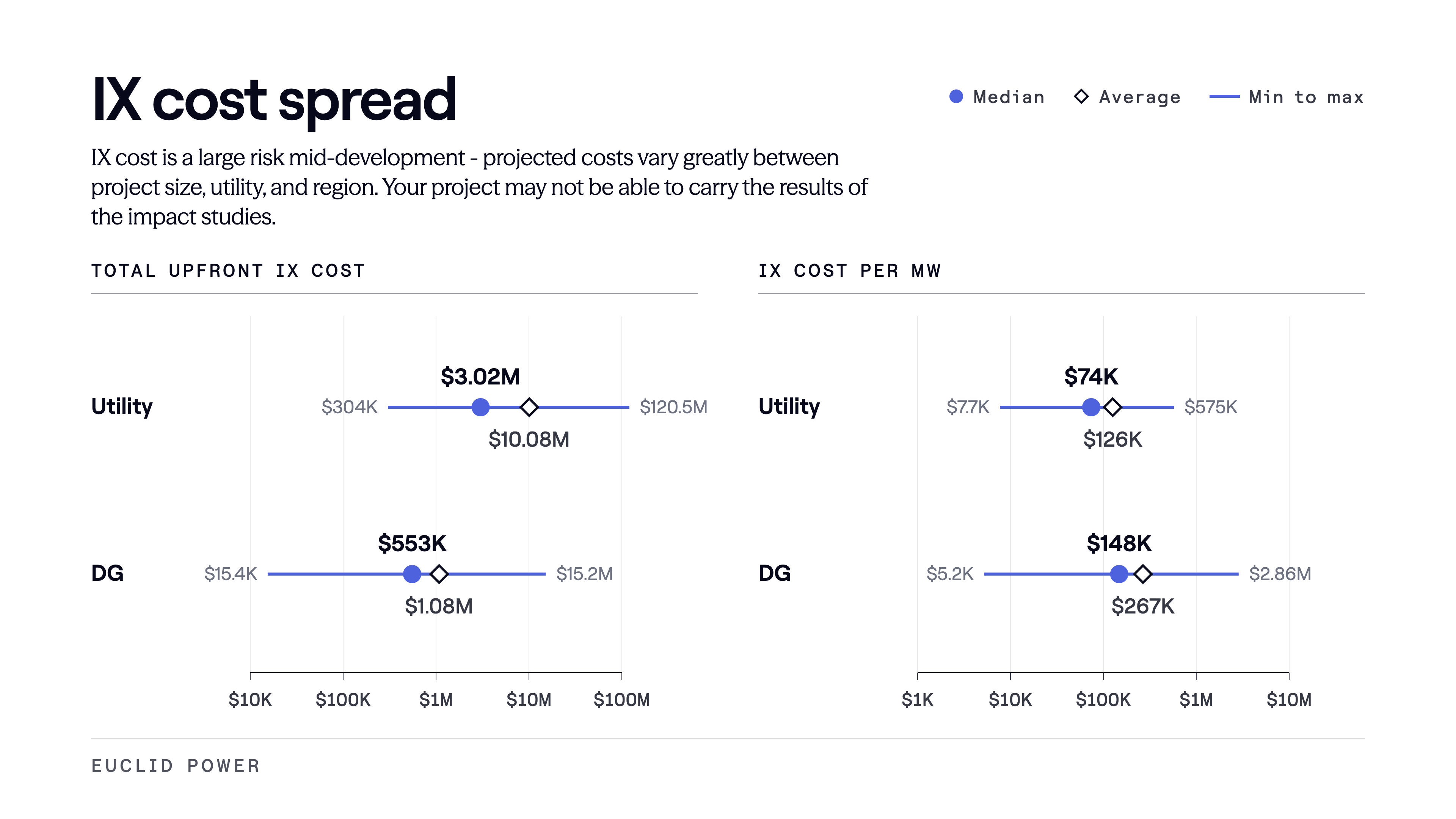
Across Euclid projects, a median of 1.5 years for DG projects and 2.5 years for utility projects elapses between interconnection application and agreement receipt. The financial volatility in interconnection costs can make or break a project. For Euclid projects, a typical utility-scale project has a median upfront interconnection cost of $3 million, but the average cost is far higher at $10 million. This sharp disconnect shows a heavily skewed risk profile, driven by a tail of exceptionally expensive outlier projects that peak at an astronomical $120 million. For a developer prior to any system impact studies, this massive spread represents a blind gamble.
Site Control
Site control involves more than confirming that a lease or option has been executed. 70% of Euclid projects have a site control or real estate-related risk regardless of the stage they’re in. Buyers need to understand if the project has secure rights to the land it needs, and be aware of any third-party agreements, easements, and title or survey issues.
Euclid supported a project where a gas pipeline ran directly beneath the proposed BESS location. The survey identified the pipeline, but the development team hadn’t initiated an agreement with its operator. Without an agreement, the project could have become infeasible at its planned location, potentially requiring a major redesign and reducing its capacity.
Model potential capacity impacts and run scenarios based on the percentage loss of capacity. The purchase price will need to reflect this distinction.
Permitting
Permitting risks vary by jurisdiction and approval type. Federal permits come with risks, as discussed in our overview of federal permitting reform, but are often ministerial in nature. On the other hand, municipal permits are typically discretionary and much less predictable, especially where local restrictions or community opposition threaten a project’s viability. According to Heatmap, there’s a permitting crisis in renewables, with a fifth of U.S. counties restricting development as of 2025.
Buyers should review applicable zoning ordinances, local permitting requirements, and any restrictions on renewable development. The status of comparable projects in the jurisdiction and the results of early community engagement can also help indicate how a project might be received.
ITC Eligibility
If a project’s economics depend on the Investment Tax Credit (ITC), buyers need to evaluate for qualification or disqualification due to the new Prohibited Foreign Entity (PFE) rules, any multipliers or adders like Prevailing Wage and Apprenticeship (PWA) and Domestic Content, and whether the documentation supports those assumptions. Eligibility depends on meeting the requirements and documenting compliance.
Review the basis for the project’s assumed eligibility, including relevant expenditure records, procurement documentation, contracting, and the schedule for satisfying applicable requirements. Identify any gaps that could jeopardize qualification and total credit percentage or require additional spending. The acquisition price should account for tax credit exposure rather than treating the expected benefit as guaranteed.
Step 3: Calculate a Risk-Adjusted Acquisition Price
A map of remaining milestones shows that each development hurdle requires its own spend, and each carries a real chance of failure. Risk-adjusted value accounts for these facts at the same time: it takes the previously assigned NTP valuation, discounts it by the likelihood the project actually gets there, and subtracts the development spend expected along the way.
Of course, this is an art in itself—a real underwriting model would account for the time value of money, the buyer’s target return, and a broad range of risks and cost uncertainties.
Step 4: Turn Value Into a Bid and Payment Schedule
With a risk-adjusted value established, translate it into a bid and payment schedule. Sanity-check the assumptions: Does the price cover remaining development costs and meet your target returns? Would the deal still work if costs go up or milestones get delayed?
Structure payments to reflect the project’s remaining risks. For continuous risks, such as uncertain interconnection upgrade costs, use price adjusters—for example, a dollar-for-dollar price reduction for costs above an agreed threshold. For binary risks, use milestone payments that defer portions of the development fee until key outcomes are achieved.
The goal is to land on a bid that accounts for the project’s risk-adjusted value and a payment structure that aligns your spending with progress toward NTP.
Enjoying this deep dive?
Stay up to date on market insights for teams who build, buy, and finance renewable projects.