When grid-scale batteries first started gaining traction in U.S. power markets in the early 2010s, many found their first business opportunity in ancillary services. Their ability to respond almost instantly to changes in grid frequency made them well-suited to frequency regulation.
But as deployment has grown, competition has driven down prices, and battery owners are relying more on energy arbitrage and capacity payments to generate returns. This shift puts more emphasis on a battery's performance over its operating life. Reaching commercial operation (COD) is just the beginning: Long-term project economics depend on how effectively the asset captures revenue, maintains availability, and manages degradation. Decisions made during construction—from equipment integration and performance guarantees to plans for future augmentation—can have lasting consequences for operating costs and revenue.
The BESS Revenue Stack Is Changing
Battery projects can be monetized in multiple ways, but the relative value of the various opportunities is changing. In ERCOT, ancillary services' share of battery revenue fell from 84% in 2023 to 48% in 2025, while average annual revenue per kilowatt dropped from $193 to near $29. Texas installed more new solar capacity than any other state in 2023 and 2024, but the battery storage that accompanied that growth led to rapid market saturation. Battery project owners are thus looking to energy arbitrage and capacity payments to support their project economics.
Energy arbitrage involves charging when wholesale prices are low and discharging when they’re high, earning the difference after accounting for round-trip efficiency losses. Growing solar generation is creating more pronounced differences between midday and evening prices. In New England, for example, behind-the-meter solar has contributed to a growing number of days when grid demand dips during midday before rising again in the evening. ISO New England recorded its 500th “duck curve” day in September 2026.
Capacity and resource adequacy payments pay battery owners to have their systems ready to supply electricity when the grid needs it most. Unlike merchant arbitrage, longer-term contracts or capacity commitments can make this revenue more predictable. As electricity demand grows and baseload coal plants are retired, these arrangements are becoming more important—but the opportunities vary widely by market.
The available revenue streams, and the names used for them, also differ across grid regions, for example:
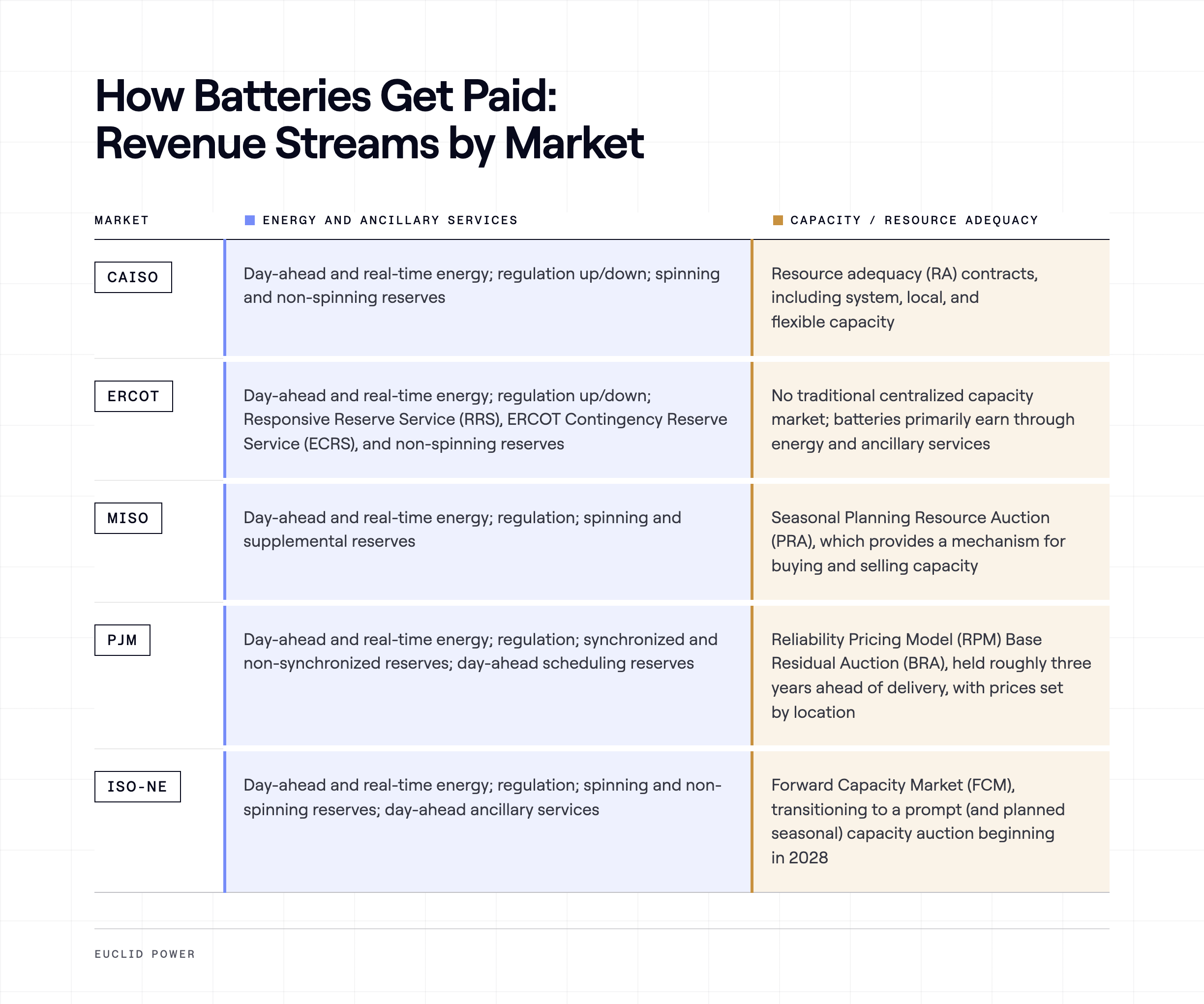
The mix of available revenues affects not just project economics, but also operating strategy. Owners need to weigh the value of each opportunity against the battery's operating limits, contractual commitments, and competing uses.
Construction Contracting: Decisions Made in Construction Live With You in Operation
The way a battery project is structured during construction can have lasting consequences for its operation. On a BESS-only project, the battery integrator typically supplies the battery system, while an EPC contractor builds the balance of plant (BOP), including electrical infrastructure and other supporting equipment. These responsibilities need to be clearly defined and coordinated.
If the integrator and BOP EPC don't establish clear boundaries for their respective scopes, problems that come up after COD can lead to finger-pointing instead of timely fixes. For example, a performance issue could involve the battery equipment, electrical connections, controls, or integration between systems. If it's unclear which party is responsible for diagnosing and resolving the problem, repairs can take longer, keeping the battery offline and potentially costing the owner revenue. Contracts should spell out responsibilities for commissioning, system integration, troubleshooting, and warranty claims, including how the parties will work together when a problem crosses their respective scopes. They should also define the performance guarantees the asset will be measured against: tested capacity at COD, round-trip efficiency (including where it is measured, since figures at the battery and at the grid connection can differ by several percentage points), the warranted capacity-retention curve, and availability.

Construction is also when owners need to plan for battery augmentation. Battery capacity declines over time as cells degrade, with the rate of decline depending on operating conditions and cycling patterns. In one eight-year study of a utility-scale lithium-ion system, researchers found that usable capacity fell by almost 13%. Many projects need to add more batteries over time to make up for this loss of capacity and maintain performance.
Owners can install more capacity upfront or design the site to accommodate future additions. Building extra capacity at the outset increases initial capital costs, but avoids some of the uncertainty of sourcing and integrating equipment later. Deferring augmentation can reduce upfront spending, but requires planning for additional space, electrical infrastructure, and permitting. It also introduces technology and supply-chain risks: the same battery model may no longer be available when the project needs more capacity, potentially complicating integration with the existing system. Batteries bought later are also subject to the trade and tax-credit rules in force at that time, including tariffs on imported lithium-ion batteries and prohibited foreign entity restrictions on storage tax credits.
On the other hand, augmentation can also create value beyond restoring lost capacity. Adding energy to an existing system while keeping its power rating the same, for example taking a 1.5-hour battery to 2 hours, can meaningfully expand its revenue opportunity. This is especially true in arbitrage-driven markets, where evening price peaks often last longer than a short-duration battery can discharge. The extra duration lets the asset stay in the market through the full peak instead of running out partway through it.
These choices affect both the cost of maintaining a project's performance and its ability to generate revenue over time. They should be part of the construction and contracting strategy from the start, not decisions left until capacity has already declined.
BESS O&M: Managing Availability and Operating Costs
The availability of a BESS directly affects its revenue. If a system can't charge, discharge, or provide grid services when they’re needed, it will start bleeding dollars quickly. Keeping things running involves more than routine maintenance.
Clear responsibility for equipment failures.
Battery maintenance, BOP maintenance, and equipment warranties are often spread across multiple parties. For example, if a battery container overheats, the fault could lie with the integrator's cooling system or with the site-built power supply that feeds it, and each party may point to the other. If their responsibilities don't align, gaps in coverage can slow down troubleshooting and repairs. Owners need clear agreements covering who diagnoses problems, supplies replacement parts, and pays for repairs.
Relatedly, prior to the EPC contractor's warranty expiry, an end-of-warranty inspection can provide significant value in identifying early operational issues while the contractor is still obligated to fix them.
Operating limits and warranty requirements.
Interconnection agreements may have curtailment requirements, while battery warranties typically set limits on cycling, state of charge, and operating temperature. A dispatch strategy that pushes beyond those limits may increase short-term revenue but risk warranty coverage or accelerate degradation. Owners need to understand these constraints when deciding how to operate the asset and which market opportunities to pursue.
Access to battery performance data.
Owners need visibility into battery health, degradation, and operating performance to identify problems early and verify that the system is meeting its guarantees. If the integrator controls access to detailed performance data, owners may not be able to easily spot problems early or check whether warranty and performance guarantees are being met.
Spare parts and planned downtime.
Having critical spare parts on site can cut repair times from weeks to hours, especially when replacement components would otherwise need to be shipped from overseas. An EPRI-led analysis of BESS failure incidents found that few were caused by cell or module defects, so a spares plan should cover the inverters, cooling, controls, and electrical equipment around the batteries as well as the batteries themselves. Planned maintenance and software updates also take the system offline, even when the work is scheduled. Owners should account for this downtime when forecasting availability and revenue.
Auxiliary power costs.
Battery systems use electricity to run equipment such as cooling and controls systems. Solar projects also have auxiliary loads, but these are usually relatively small. For BESS, consumption can be much higher depending on the battery technology and system design. The electricity may be billed at retail rates and subject to demand charges, making auxiliary power a significant and unpredictable operating cost.
Protecting Returns Beyond COD
In summary, a battery's financial performance doesn't end at COD. As revenue opportunities shift toward energy arbitrage and capacity payments, long-term returns depend more on how well owners manage the asset throughout its operating life. Clear construction contracts, realistic augmentation plans, and effective maintenance all help protect availability and control costs. For developers and independent power producers, long-term returns come down to keeping batteries operating reliably and capturing revenue throughout their useful lives.
Enjoying this deep dive?
Stay up to date on market insights for teams who build, buy, and finance renewable projects.