The renewable energy industry has developed sophisticated frameworks for evaluating project risk. Interconnection uncertainty, permitting timelines, tax credit compliance, and equipment procurement have each become a defined category with established tools and processes for assessment and mitigation. What receives comparatively less systematic attention is the quality of the IPP-EPC relationship itself: how it is structured, how the contractor is selected, and how the agreement is managed from pre-mob through commissioning.
This gap matters. In our experience working alongside IPPs and system owners, the EPC relationship is frequently the single largest execution variable in a project, and the one most likely to determine whether a well-underwritten deal delivers its projected returns. We've found that IPP execution teams which consistently turn over high-quality, model-beating projects have developed intentional practices around three areas that many of their peers overlook.
Lever 1: Treating EPC selection as a strategic investment
There’s no question that EPC selection is the most critical stage in the project lifecycle. But all too often, that selection is based on price alone, or a combination of price and a compelling pitch by the EPC’s leaders. In our experience, however, most IPPs undervalue a holistic diligence of the EPC, specifically of the teams ultimately responsible for executing the work.
The standard diligence process focuses on financials, safety records, and project references, with the bulk of relationship-building occurring at the executive level. EPC CEOs and business development leaders are typically strong communicators who carry a coherent vision for their company's culture and capabilities. The challenge is that the individuals who shape the actual experience of working with an EPC on a day-to-day basis are the project manager assigned to the job and the execution leadership who oversees them. These are the people resolving scope ambiguities, managing change orders, and making real-time decisions about how to handle deviations from plan, and they may operate with a culture and set of habits that differs meaningfully from what is presented at the executive level.
A more effective approach is to request introductions to the regional leadership team—specifically the likely PM and regional director—before contract execution, not after. References should be sought from owners who worked directly with that regional team on comparable projects, not just from the EPC's broader client list. The questions worth focusing on in those conversations are practical ones: How did the PM handle the contract? How were change orders managed? Were there disputes, and how were they resolved?
What is being assessed, ultimately, is whether the execution team, rather than the corporate leadership team, has a culture of contract adherence and process discipline—and whether that culture is consistent all the way through to the on-site team. These qualities are difficult to evaluate from a distance and easy to overlook in a competitive bid process, but they are strongly predictive of project outcomes.
There is also a portfolio-level consideration worth naming directly. An EPC with a coherent, top-to-bottom culture of quality and contract adherence will often carry a higher price than alternatives. In our observation, it is not uncommon to see that premium recovered in schedule predictability, reduced change order volume, and fewer defects at commissioning, particularly for owners managing multiple projects with the same contractor. The selection decision is worth framing as an investment in a working relationship, not simply a procurement exercise.
Lever 2a: The EPC agreement as a path to execution, not litigation
By and large, EPC agreements are crafted to provide maximal legal protection to the IPP in the event of future disputes. While an IPP’s form EPC Agreement approach may satisfy (and even excel) in this regard, many fail in their most basic mandate: to lay out a clear and unambiguous path along which the project is to be built and commissioned. Rather, too often EPCs are left to navigate a dense, technically complex document with aggressive risk allocation, layered indemnities, and language that is difficult to parse outside of a legal context.
Under ideal pre-construction conditions, with ample time to review the EPC-A, scope of work, designs and permits, an EPC PM will still be faced with a dense, unintelligible wall of contractual language. In reality, project managers responsible for executing the project plan are rarely (if ever) afforded the time or legal support to digest and interpret the EPC-A in its entirety—the demands of active construction simply do not permit it. In practice, PMs default to the patterns and procedures they have always used, which may or may not reflect the specific terms that were negotiated. When a conflict arises between the agreement and the EPC's established practices, it tends to surface on-site, mid-construction, at the point of highest cost and lowest leverage.
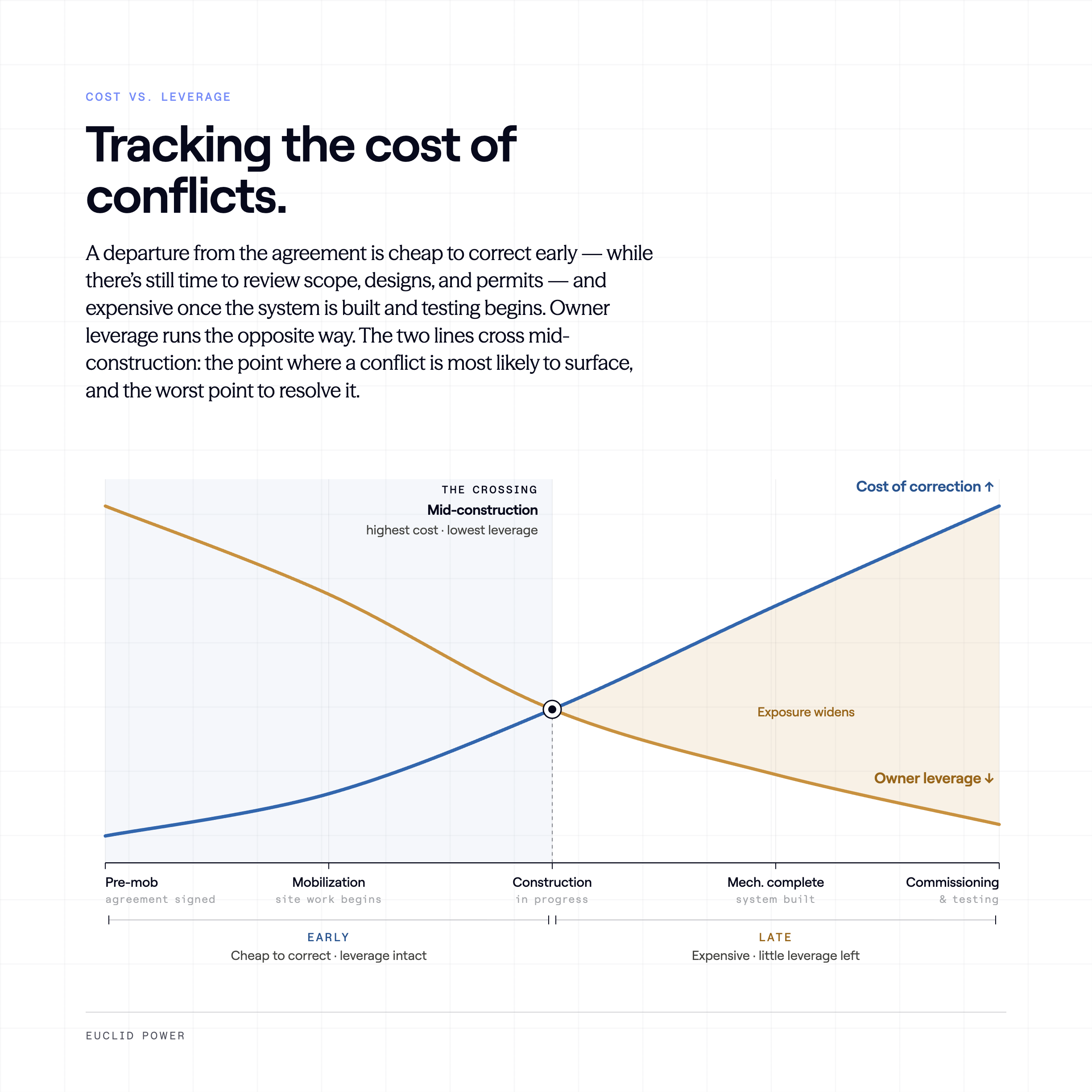
The underlying dynamic is worth stating plainly: an agreement written to be maximally protective in a dispute scenario tends to increase the probability that a dispute will occur. The harder the agreement is to build to, the more likely the project departs from its terms—and the more likely those departures become points of contention.
A more effective philosophy is to approach the EPC agreement as a document that is designed first to be executed, and second to provide protection. This means simplifying scope language, reducing ambiguity in key deliverables, and concentrating complexity in the provisions that genuinely matter—performance guarantees, commissioning acceptance criteria, and defect remediation obligations. It may also mean accepting a somewhat more balanced risk allocation in exchange for an agreement that the EPC's field team can actually work within.
Lever 2b: Establish a repeatable execution framework
The second dimension of this lever is the management framework built around the agreement. Signing the contract and transferring accountability to the EPC is a common pattern (EPC PMs often complain of contracts being “signed, then thrown over the fence” to them) and a common source of lost control. The owner's interest is better served by establishing a clear, fair, and consistent process for managing the agreement on a day-to-day basis: regular compliance check-ins, agreed protocols for change orders and RFIs, defined escalation paths, and documentation standards that are practical rather than burdensome.
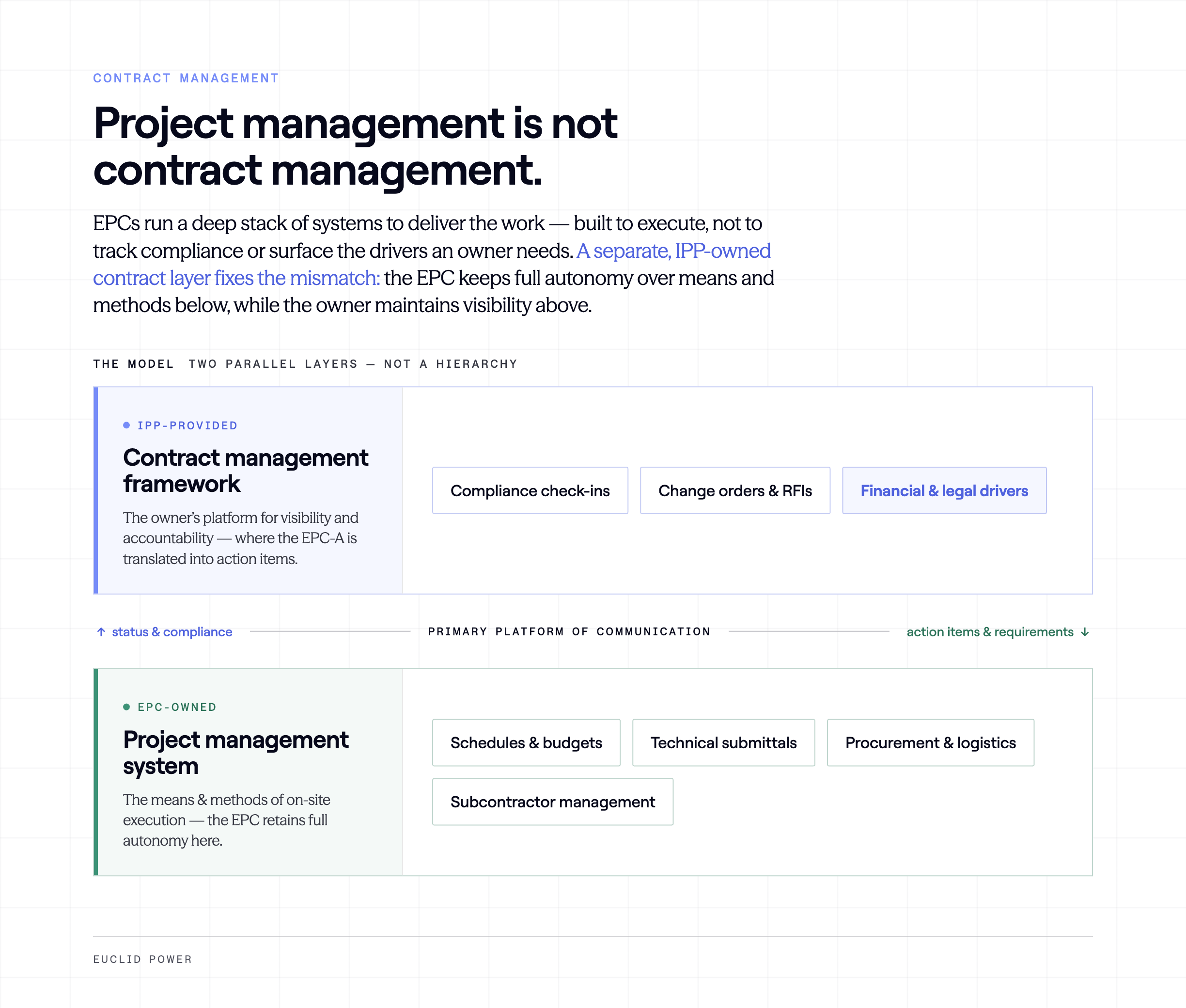
It’s important to distinguish between project management systems and contract management systems. In order to deliver high-producing systems on time and on budget, the EPCs maintain a complex web of schedules, budgets, a technical submittals manager, subcontractor management systems, procurement and logistics, etc. These project management systems enable the execution of the work to be done, but they are insufficient and poorly suited to manage contract compliance and provide IPPs with visibility into key financial and legal drivers. The status quo is that IPP execution managers are granted access to the EPC’s project management systems, and left to extrapolate the data that is critical to them.
We recommend a separate, IPP-provided contract management framework that serves as the primary platform of communication between the IPP and EPC – effectively, a system by which the EPC-A is translated into interconnect action items and requirements.
By distinguishing between the project management and contract management layers, and allowing each to serve their purpose, EPCs maintain autonomy in the means and methods by which they conduct and manage on-site activity, while IPPs maintain the oversight and visibility into the key contractual drivers that they deserve as project owners.
The objective is not to become a management layer sitting above the EPC, but to maintain visibility and accountability through a system the EPC can operate in straightforwardly. When the management framework is well-designed, EPCs tend to perform better within it—not because they are more closely supervised, but because the expectations are clear and the path to compliance is unambiguous.
Lever 3: Ensure quality by getting ahead of commissioning
Quality assurance in solar and storage construction has traditionally been managed via on-site oversight – full-time on-site presence of IPP personnel throughout construction to observe, document, and flag issues in real time. But for many project types, particularly distributed generation, as market changes have compressed project budgets, the economics no longer support a continuous, heavily-staffed site presence. The practical question becomes one of process efficiency: how can we repeatably achieve quality outcomes without access to real-time site presence?
The answer, in our experience, lies in two related practices: targeted pre-negotiated quality checkpoints during construction, and rigorous commissioning planning that begins well before construction is complete.
Pre-negotiated quality checkpoints—golden row inspections, mechanical completion criteria, electrical pre-commissioning walkthroughs—are a recognized tool, though inconsistently applied. Their value is in creating structured moments of accountability at high-leverage points in the construction sequence, without requiring continuous site presence.
Commissioning planning is the area we find most consistently underdeveloped. By the time a system is physically complete and performance testing begins, the cost of correction has increased substantially and the EPC's motivation to remain on-site has decreased. If the standard for a successful commissioning has not been defined in advance—what tests will be run and by whom, what format results must take, what constitutes an acceptable outcome, and what triggers corrective action—then those standards must be negotiated in real time.
The practical implication is that commissioning planning should begin no later than the start of mechanical installation. Defining acceptance criteria early serves two functions simultaneously. First, it communicates to the EPC's field team what a successfully completed project looks like before they have finished building it—a lead measure that tends to improve workmanship. Second, it preserves the owner's leverage: clear, unambiguous standards make it possible to identify defects and require remediation while the EPC is still on-site and the financial terms of the relationship still provide meaningful incentive to perform.
Projects that commission cleanly and reach financial milestones on schedule almost always reflect a commissioning plan that was established early and communicated clearly. The inverse is equally consistent: vague commissioning standards tend to produce disputed results, delayed remediation, and assets that underperform against modeled projections.
Enjoying this deep dive?
Stay up to date on market insights for teams who build, buy, and finance renewable projects.