Solar projects break ground with carefully-developed budgets, detailed construction schedules, and a long list of assumptions about labor productivity, equipment delivery timelines, weather conditions, and permitting milestones. However, everyone involved knows things tend not to go according to plan.
McKinsey cites research from 2017 showing that across a database of 16,000 projects, only 8.5% met their cost and schedule targets. A 2023 survey of senior project executives found that projects overran their budgets and schedules by an average of 30 to 45 percent.
Bad weather delays site work; design modifications happen during construction; supply chain issues affect procurement schedules. These surprises are just part of project execution, but given how much money is on the table, strong project controls and risk mitigation strategies are crucial. Projects with strong controls tend to be able to absorb disruptions without too much negative impact, while others fall into a cycle of delays, cost overruns, and increasingly difficult recovery efforts.
Many underperforming projects start out with sound plans and reasonable assumptions, then their problems come out through small deviations that compound over time.
The highest-performing projects identify problems early, understand their implications quickly, and respond before there are material threats. In an industry where project economics are becoming more sensitive to factors like construction timelines, financing costs, and revenue generation timing, forecasting and managing variance well can be a major competitive advantage.
Projects rarely fail because of a single event
When project teams look back on cost overruns or schedule delays, they often try to pinpoint a defining moment or factor, like a contractor that underperformed or a permit that took longer than expected. But there’s usually an accumulation of issues that, taken individually, seem minor: engineering deliverables arriving a few days late, field productivity falling slightly below expectations, change requests staying open for longer than planned.
These little delays can add up in a way that completely changes project outcomes. By the time a project is visibly behind schedule or significantly over budget, the underlying causes may have been developing for months.
This is where project controls create value. At their core, project controls provide a framework for detecting variance before it becomes visible in headline metrics. They transform project management from a reactive exercise into a predictive discipline focused on forecasting outcomes.
Earned value management: Turning progress into insight
One of the most powerful tools in project controls is earned value management (EVM). At a high level, EVM compares three things: the work that was planned, the work that has actually been completed, and the money that’s been spent. This comparison shows whether physical progress is keeping pace with resource consumption. Surprisingly, it’s a metric that traditional status reporting often misses.
Consider a project that has consumed 70% of its construction budget—but only 55% of the planned work has actually been completed. Spending and progress are clearly not aligned. If a project’s actual costs to date are only compared to planned costs, without including a measure of physical progress, the results may not be very helpful since the correlation between progress and spending isn’t clear.
Without earned value analysis, teams may continue reporting that construction is proceeding normally while underlying performance deteriorates. By the time the budget overrun becomes obvious, too much damage may already be done; earned value tracking gives project teams an earlier signal so they can take action before it’s too late.
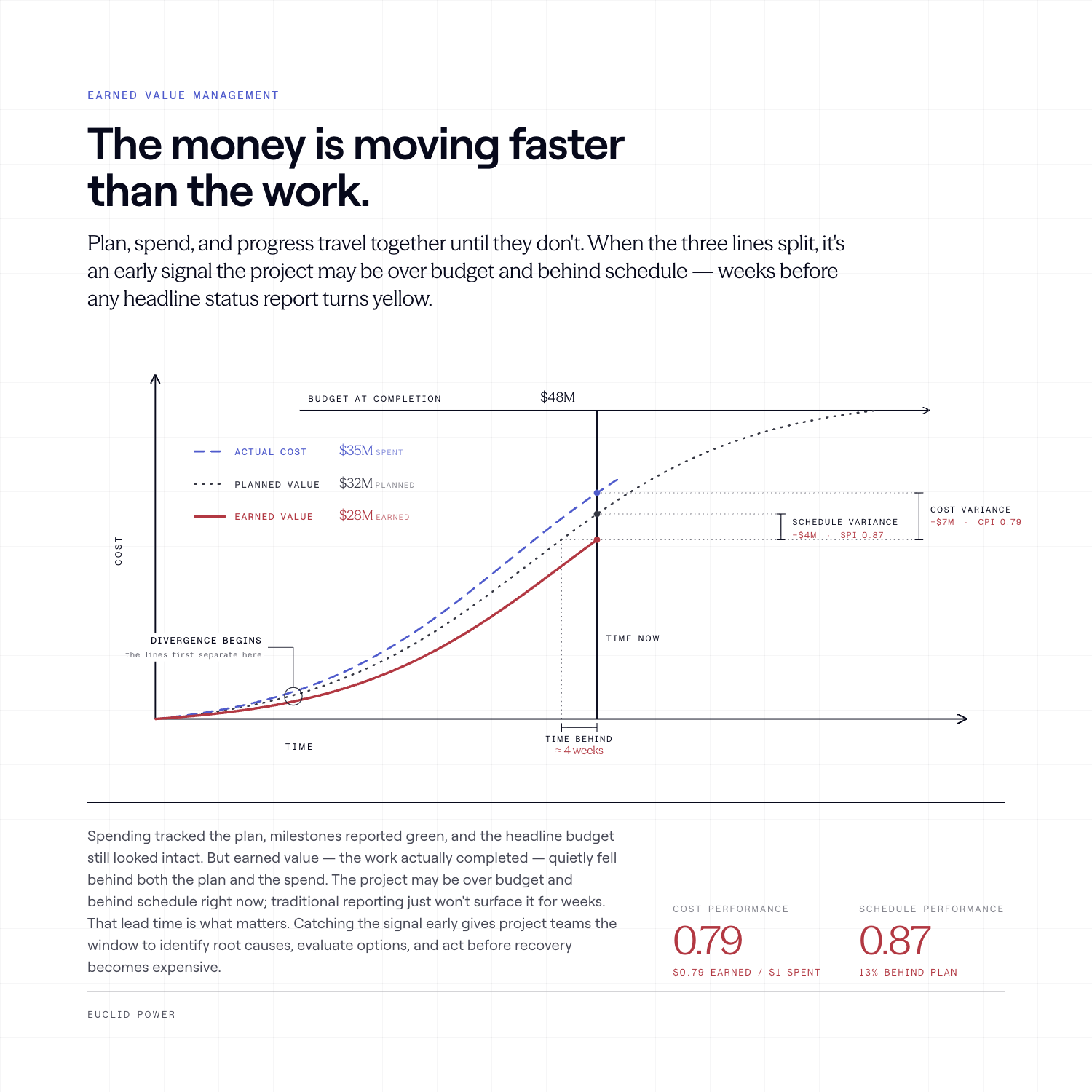
Action can mean deploying more resources, adjusting work sequencing, investigating productivity issues, or revising forecasts, to name just a few examples. The most important point is that decisions can be made while there’s still opportunity for course correction.
Schedule float: Insight into the present and the future
Budget variance is just one component of project performance. Schedule risk can be equally consequential, especially with projects where delays can affect financing assumptions, power purchase agreements, tax credit timelines, or revenue expectations.
A lot of project teams evaluate schedules mainly through milestone tracking, but that can paint an incomplete picture. Schedule float is a far more informative metric. Float is the amount of schedule flexibility available before delays start affecting downstream activities or overall project completion. Think of it as a buffer between minor disruptions and major schedule impacts.
Like any resource, though, float can be consumed. A project can technically remain on schedule while steadily burning through its available float. By the time there’s a critical activity delay, there may be little flexibility left to absorb the impact. This is why good project controls programs look at float consumption trends. A project that has used up most of its schedule float may be riskier than one that's experienced a small delay but still has room to absorb future setbacks.
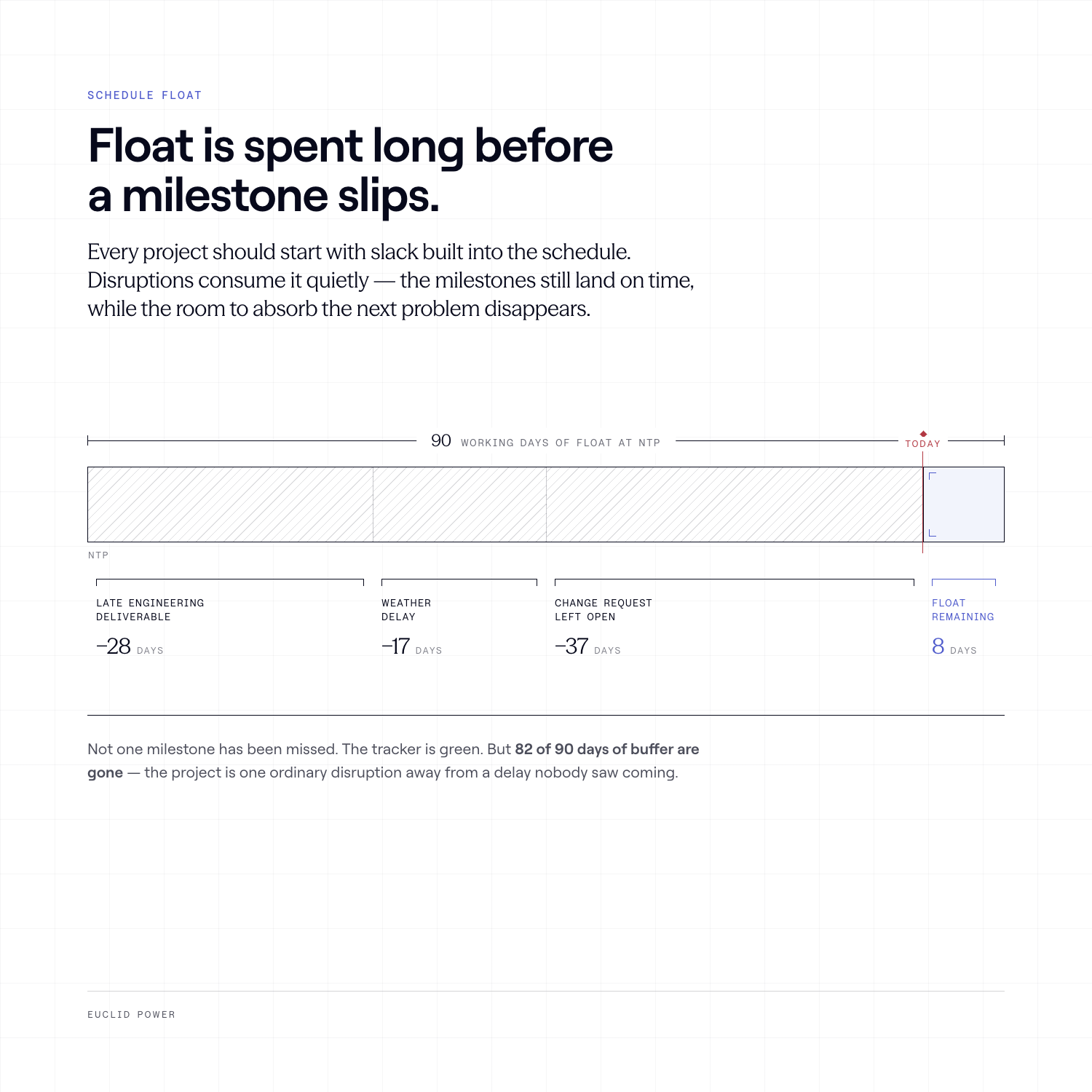
Monitoring float provides insight into the future health of the schedule, not just its current status. Once float is exhausted, recovery becomes more expensive and disruptive, and less certain.
Change orders: Where small problems turn into big ones
Change order discipline measures a project’s ability to manage uncertainty. Projects inevitably evolve during their execution; design modifications, equipment substitutions, scope refinements, and regulatory shifts are all fairly standard. But they become a problem when they're not tracked well or when teams don’t update cost and schedule forecasts to reflect them.
In a lot of troubled projects, work continues while change orders sit unresolved. This leads to extra costs being incurred before their impacts are fully understood, or schedule implications not being incorporated into baseline forecasts. It’s also common not to assess the downstream impact of changes. For example, an EPC labor change order that delays COD would extend project management, equipment, and other indirect impacts that wouldn’t be included in the CO.
Over time, the gap between project reality and project reporting widens, and teams are relying on budgets and schedules that don’t reflect conditions on the ground. This makes decision-making harder because nobody is working from a consistent understanding of project status.
Effective change-order discipline prevents this disconnect. Every change should be documented, quantified, approved, and integrated into updated cost and schedule forecasts. Keeping changes visible makes it easier to hold responsible stakeholders accountable, and dramatically improves forecasting.
Visibility drives performance
Most project controls failures come down to execution. The industry has well-established frameworks for earned value management, schedule analysis, forecasting, and change management. But project information is often fragmented, living in disconnected spreadsheets, contractor reports, and scheduling systems. Teams may have all the information they need to identify emerging risks, but lack visibility to connect those signals into one coherent picture. Centralized project data lets teams identify variance earlier and evaluate impact more consistently.
A recent survey from the Project Management Institute found that teams that effectively navigate complexity are five times more likely to deliver successful projects. Strong project controls give them the data and visibility they need to manage that complexity instead of belatedly reacting to it.
They also make outcomes more predictable. Project controls used to be viewed mostly as an operational function, but now they’re just as much a financial function. As renewable energy projects get bigger and more capital-intensive, investors and lenders want to maximize predictability. Uncertainty can get expensive, so stakeholders want to feel confident in a project’s forecasts throughout construction.
Every project is going to have some surprises; the ones with effective project controls will know where they stand the whole time, and end up performing best.
Enjoying this deep dive?
Stay up to date on market insights for teams who build, buy, and finance renewable projects.