Last April, a major equipment failure shut down Sandy Creek, the largest new coal-fired power plant in the U.S. The plant, a 632MW facility, is not expected to come back online until 2027. In the meantime, almost 70 GW of new solar capacity will be added, and by 2027, solar power will make up 10% of U.S. electricity generation. Solar assets don’t usually fail catastrophically; they are unlikely to experience the kind of long-term equipment failure that closed Sandy Creek, or the scale of weather-related forced outages that plagued PJM gas plants during Winter Storm Gerri in January 2024.
For solar assets, production losses accumulate quietly, one tracker row at a time. Misalignment goes uncorrected, vegetation creeps past spec, soiling lingers longer than planned. Over time, documentation drifts, performance assumptions go stale, and small gaps open between what is modeled, what is contracted, and what is actually happening in the field. None of these issues shut a plant down. But together they steadily bleed value, showing up as lower P50s, missed revenue, tougher refinancings, and impaired exits.
In the first installment of this series, we explored how soiling, spares and downtime can challenge a model’s assumptions and lead to persistent underperformance when left unmanaged. In our second installment, we’ll dig deeper into two operational and often subtle drivers of underperformance: vegetation management and tracker drift.
Unbundling vegetation management
A project’s financial model is built to make a credible case for how an asset will perform over a 25–30-year lifespan, even as aging introduces new expenses such as module deterioration or equipment replacement. In many financial models, vegetation management is implicitly bundled into the O&M line item and treated as a fixed, annually escalating cost, even though it is frequently contracted as a supplemental service outside the fixed-fee O&M agreement. While this approach makes sense from an underwriting perspective, it underestimates the impact that vegetation can have on the cost and performance of an operating project.
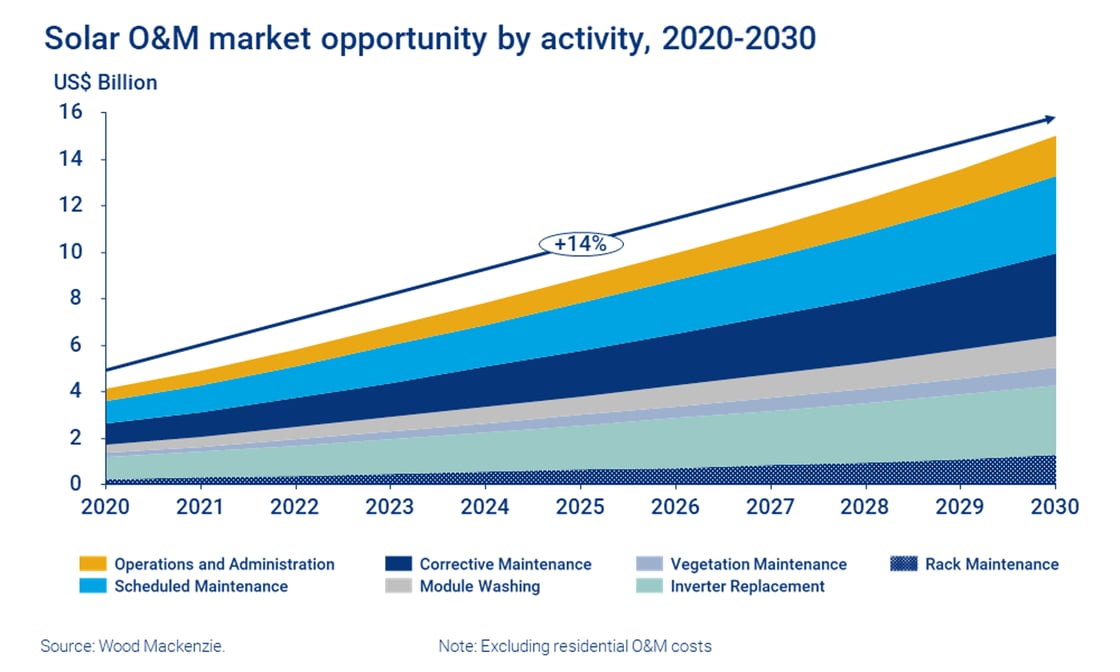
Standard O&M contracts typically do not include vegetation management within the fixed fee. Instead, vegetation control is most often offered as a supplemental service, priced separately on a $/kW or $/acre basis and scoped based on an assumed number of mowing or treatment events. When these activities are not modeled, under-modeled, or incorrectly scoped (for example, assuming too few mowing cycles or omitting vegetation entirely), the resulting cost exposure can be significant given the land area required for utility-scale solar facilities. For a mid-size utility-scale project (~160 MW), annual vegetation costs can exceed $400,000. Vegetation growth is highly site-specific and driven by rainfall, soil conditions, and layout, making it poorly suited to rigid schedules. If owners attempt to mitigate a modeling miss by reducing vegetation activity, this can introduce operational risks, including tracker drivetrain failures, increased shading losses, elevated fire risk, and pest damage. As a result, vegetation management represents a material and variable operating cost that is frequently outside standard O&M scope and must be explicitly and realistically budgeted.
At utility-scale sites with native ground cover, mowing averages approximately $121 per acre, while weeding adds another $93 per acre. Using a typical land-use assumption of roughly 6–7 acres per MWdc, a single additional, unplanned vegetation management pass equates to roughly $1.3–$1.5/kWdc. On a 50-MWdc project, that translates to approximately $60,000–$75,000 in unbudgeted spend. Against an annual O&M budget on the order of $900,000–$1 million, a single extra vegetation pass can increase total O&M costs by roughly 6%–8% in a high-growth year. When growth conditions require multiple out-of-scope visits, these costs compound quickly, and unmanaged vegetation begins to introduce performance risk rather than remaining a purely operational expense.
Delaying vegetation management is often more expensive than doing the work. Vegetation-related performance losses manifest as incremental yet persistent reductions in energy output that are difficult to detect using standard availability metrics. Because solar modules are connected in series, shading on even a small portion of a row can reduce output across a much larger section of the array. When grass or shrubs shade the lower edge of a module or a portion of a tracker row, only a small area may be visibly affected, but the resulting electrical mismatch can reduce production across many otherwise unshaded modules. Simulation studies show that partial shading can drive module-level energy losses of roughly 3–12%, with array-level losses approaching 15% as these effects accumulate over time. As a result, vegetation shading causes performance losses that are disproportionate to the shaded area and can persist unnoticed across weeks or seasons, turning a maintenance issue into a material source of energy underperformance.
In the financial model, the cost of underestimating vegetation can show up as uncovered O&M in high-growth years and as underperformance relative to production assumptions, creating correlated downside risk to annual cash flows.
The best operators are proactive:
- Address vegetation risk through underwriting discipline. Address vegetation risk by evaluating site-specific growth patterns, access constraints, and response protocols, and by confirming that vegetation abatement costs are clearly accounted for in both the financial model and O&M contracts.
- Define vegetation performance thresholds. Set clear performance-based triggers for intervention, such as a sustained production delta relative to adjacent rows or peer sites over a defined number of days under comparable irradiance, rather than relying solely on a fixed mowing frequency.
- Maintain site-specific vegetation maps and seasonal risk calendars. Document fast-growth zones, drainage areas, fence lines, and low-clearance rows, and pair these maps with seasonal growth expectations to anticipate when vegetation pressure is likely to exceed contracted assumptions.
- Verify performance recovery after vegetation work. Include a defined post-work check, such as next–clear-day production compared to a baseline or nearby unaffected rows, to confirm that vegetation abatement restored performance and did not leave residual losses.
Drifting into energy loss
99% of new utility scale solar projects now use single-axis trackers. They deliver higher energy yield than fixed-mount systems and are cheaper and less failure-prone than dual-axis trackers, making them the dominant choice for large-scale solar. Designed to operate for decades, they are generally reliable mechanical systems. But those benefits depend on proper alignment, maintenance, and active management. After COD, those conditions often degrade gradually, reducing performance without triggering faults or downtime. Because trackers remain operational, losses can go undetected, making it critical to understand how tracker behavior affects production and long-term performance risk.
.jpeg)
Trackers are designed to keep panels oriented at the optimal angle throughout the day, but small, persistent alignment errors can cause panels to point a few degrees off target, reducing energy production without triggering alarms or downtime. These errors often originate in the mechanical system itself. Single-axis trackers are complex assemblies, with motor units comprising more than 60 components, including bearings, fasteners, and joints that must maintain tight tolerances to achieve accurate rotation. Analysis shows that over 77% of reported issues in non-fixed-mount systems involve fastener-related components, such as bearings, nuts, and bolts, and that these issues emerge on average 1.7 years after systems begin operating. Rather than causing outright failure, fastener loosening, wear, or corrosion typically introduces resistance that causes trackers to drift away from their intended angles while remaining operational. This drift directly impacts production. Recent field analysis of a 5MW operating PV plant found real world energy losses of 1% due to tracker misalignments of several degrees. At current average U.S. solar PPA prices (around $56.76/MWh), a 1% annual energy loss at a 50-MW plant corresponds to roughly 1,100 MWh of lost generation per year, or about $60,000 in foregone revenue annually, purely from tracking inaccuracies.
In addition to mechanical drift, tracker performance is strongly influenced by how systems enter and exit stow positions. In simulated clear-sky conditions, a tracker that stops tracking and holds a fixed orientation can experience up to ~50% reduction in energy output during the stall period compared with proper tracking. Modern trackers use sensor-based stow logic to protect equipment during high winds or other adverse conditions, but these strategies are highly product- and site-specific. Stow thresholds, persistence timers, and exit logic vary widely by manufacturer and project design, meaning two otherwise similar sites can spend very different amounts of time parked under comparable wind conditions. In one modeled comparison, a rigid tracker stowed at zero degrees spent just 15 hours per year in stow, representing 0.17% of annual hours and resulting in 204 MWh of lost generation, or roughly 0.09% of projected output, corresponding to a revenue loss of just over $5,700. A traditional tracker with a lower wind threshold and a 30-degree stow angle spent 243 hours per year in stow, or 2.77% of annual hours, losing 1,711 MWh, roughly 0.77% of projected generation, for an annual revenue loss of nearly $48,000. The hardware remained functional in both cases; the difference was driven entirely by stow strategy. Even relatively brief or repeated stow events can compound into meaningful annual energy loss without ever triggering downtime or maintenance alerts.
Both drift and stow-related losses share a defining characteristic: they reduce production without interrupting operation. Trackers continue to move, respond to commands, and report normal availability, even as alignment errors, algorithmic assumptions, or conservative stow behavior quietly reduce energy capture. Because performance loss is incremental rather than catastrophic, it often escapes detection unless operators explicitly monitor tracking accuracy, stow frequency, and row-level production consistency. The financial impact of this behavior is subtle but material. Rather than appearing as downtime or repair events, tracker underperformance shows up as a persistent production shortfall relative to modeled expectations, eroding realized yield and P50 outcomes over time.
Best-in-class operators recognize tracker misalignment as a recurring performance risk:
- Define and monitor tracker alignment performance. Implement a row-congruence metric that flags when adjacent tracker rows fall outside a defined angle tolerance, signaling mechanical drift or control error before it translates into sustained production loss.
- Establish clear ownership and recovery checks for stow behavior. Assign a single owner for stow logic and require a standard post-stow checklist that verifies control settings, confirms that tracking resumes as expected, and validates next–clear-day production.
- Use tracker telemetry to flag mechanical degradation. Monitor motor load, response time, and position accuracy to identify emerging mechanical issues that can cause tracking drift without downtime.
Closing the gap
Solar assets rarely fail outright, instead falling short of modeled expectations through small, operational gaps that accumulate over time. Vegetation growth, tracker misalignment, and conservative stow behavior all reduce production without triggering downtime, allowing underperformance to persist even as assets remain “available.” In each case, the disconnect lies not in the model itself, but in how real-world operating conditions are managed and verified. As solar becomes a larger share of the generation mix, closing this gap — by focusing on performance, not just uptime — will be essential to protecting realized energy and investment outcomes.
Enjoying this deep dive?
Stay up to date on market insights for teams who build, buy, and finance renewable projects.